Research
Projects
ON-Cerco (Active)
Drones are increasingly used to detect crop diseases from the air, but they almost always photograph plants from straight above, missing the upright and lower leaves where many diseases develop. This DFG-funded project, led by Dr. René Heim with doctoral researcher Davide Mattioli, tests whether tilting the drone camera to view plants from many angles makes disease-detection models more robust. Using Cercospora Leaf Spot in sugar beet as a model system, the team collects multispectral data across multiple growing seasons and all crop development stages to test whether multi-view imagery improves model reliability, and whether particular viewing angles are more or less useful for crops with upright versus flat-lying leaves. The findings could help farmers target fungicide use more precisely and support the breeding of more resistant varieties.
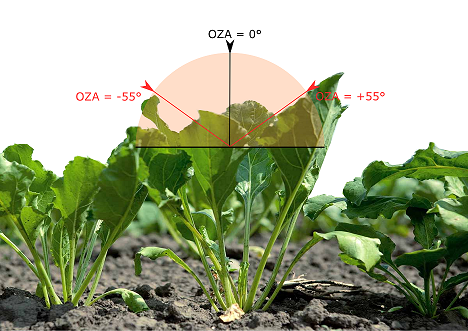

--- **At a glance** - Principal Investigator: Dr. René H.J. Heim - Doctoral Researcher: Davide Mattioli - Duration: until 30 April 2029 - Host: University of Göttingen, in collaboration with the Institute of Sugar Beet Research (IfZ) Funded by the Deutsche Forschungsgemeinschaft (DFG, German Research Foundation) – Project number: 521313940

Remotely sensed leaf area index can improve mechanistic Cercospora beticola epidemiological models for disease predictions (Completed, Published)
Plant disease epidemiological models, empirical and mechanistic, assist with disease management decisions by providing a prediction of plant disease epidemics. Yet, adoption of predictive models in integrated crop protection can be low as available decision support systems require validation, in-field scouting by growers and agronomists and, from time to time, model parameter reviews. This project investigates, whether remote sensing technologies and automation strategies can assist in this process and ease adoption.

ReflectDetect (Completed, Published)
An innovative, fully automated command line software for in-flight radiometric calibration of UAV-mounted 2D snapshot multi-camera imagery. For more information please visit the
online repository.
High interval measurement of leaf angle dynamics using stereo vision (Completed, Published)
Leaf inclination angles (LIA) are crucial for regulating various processes within the plant carbon–water–energy nexus. In agriculture, these processes include photosynthesis, leaf temperature, plant growth, and the microclimate within the canopy. Despite its significance, LIA remains one of the most understudied plant functional traits due to the difficulty of measuring it accurately, particularly at short temporal intervals. In optical remote sensing, LIA is a key factor influencing spectral variability, which directly impacts the robustness of empirical models. Together with Frederik Hennecke, a data science student at the University of Göttingen, we developed a novel and automated approach to capture 3D point clouds of small crops (e.g., sugar beet), enabling precise determination of LIA from the generated data. Our system, controlled by publicly available code, and therefore adhering to FAIR principles and open software standards, allows for customizable capture intervals and positions. The method was validated using a 3D-printed sugar beet model with known LIA, demonstrating its potential for advancing plant trait studies.
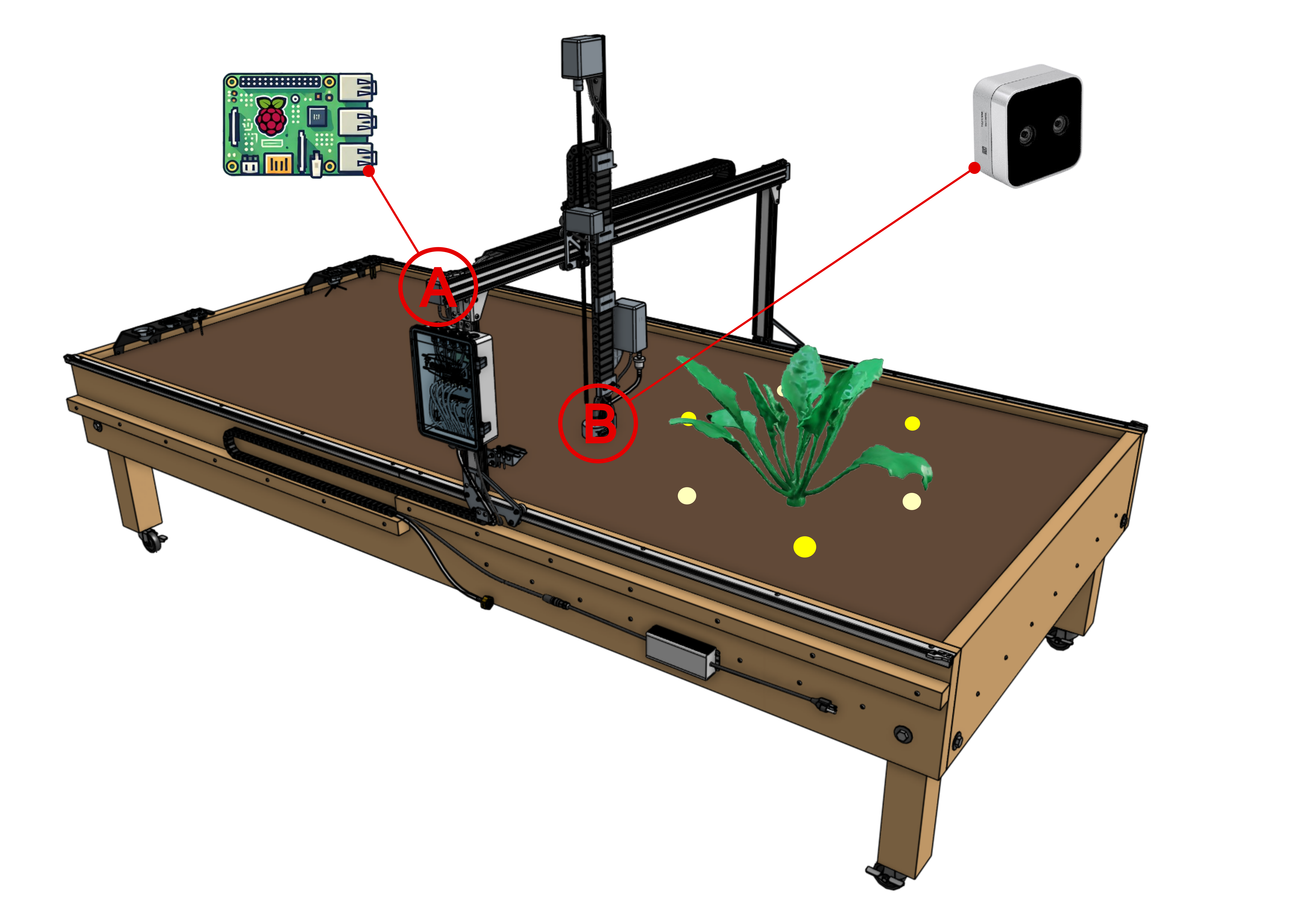
The FarmBot Genesis v1.6 was upgraded with a Raspberry Pi (A) to control the position (e.g., yellow dots) and interval of image capture events of an Intel RealSense D405 (B) depth camera. The camera was mounted at the bottom of the z-axis extrusion, while the associated Raspberry Pi was mounted above the electronic box on the gantry of the FarmBot. The camera generated 3-dimensional point clouds that served as a source for LIA retrieval. The accuracy of LIA measurement was validated with a 3D-printed plant with known LIA´s.
Evaluating spot-spraying systems in sugar beet (Completed, Unpublished)
Across multiple field site in northern Germany, it is investigated whether spot spraying can contribute to herbicide savings in sugar beet cultivation.

agrIR - Developing R programming tools for crop water stress detection and energy balance modelling (Completed, Unpublished)
We are working alongside Rikard Graß (UFZ), Hannah Boedeker (UFZ), and Marco Hofmann (HS Geisenheim) to develop software tools aimed at enhancing thermography applications in agricultural datasets.

Supervision and Co-Supervision
M.Sc. Research (Active) –Evaluating open source super-resolution of Sentinel-2 imagery for monitoring trees outside of forests
Alison is evaluating the performance of the ESA’s open source latent diffusion super-resolution (LDSR) model for estimating canopy coverage in trees outside of forests. The study site is a 50km long transect in Bengaluru which contains urban, agroforestry, and rural landscapes. The research will compare native 10m resolution Sentinel-2 imagery and 2.5m LDSR super-resolution to a 30cm Worldview “ground truth.” The aim of the study is to qualify when and where super-resolution can be trusted and be implemented as a useful tool. Alison is enrolled in the M.Sc. Program Sustainable Forest and Nature Management at the Georg-August-Universität Göttingen and the University of Copenhagen.
M.Sc. Research (Active) – Influence of landscape heterogeneity on maize productivity of smallholder farming systems of the Eastern Cape, South Africa using TESSERA embeddings, climate, soil and topography.
Aswajith is investigating whether landscape heterogeneity estimated using TESSERA embeddings is associated with spatial variability in maize productivity of smallholder farming systems of the Eastern Cape, South Africa. Yield observations are combined with environmental variables such as precipitation, temperature, soil properties and topographic characteristics to determine whether measures derived from TESSERA provide additional information apart from established factors of maize productivity.
B.Sc. Research (Active) – Benchmarking Open Databases for the Spatial Distribution of Alternative Host Plants
Christina's thesis addresses the "bottleneck" of reference data in landscape plant epidemiology by focusing on the distribution of wild alternative host plants and their role in disease dynamics. The research evaluates whether open repositories can provide reliable spatial data to identify where these hosts occur and how their spatial distribution informs landscape-scale disease risk mapping. To achieve this, the project develops a comprehensive benchmarking framework that assesses databases across several dimensions, including taxonomic precision, FAIR compliance, and spatial sampling bias. A further central focus of the work is investigating the spatial heterogeneity of wild host plant populations, assessing whether their distribution shows the necessary clustering or fragmentation to provide meaningful explanatory power for landscape-scale disease risk models. Ultimately, this research supports the development of spatially explicit risk assessments in (agricultural) landscapes by identifying high-quality reference data for remote sensing models. Christina is enrolled in the B.Sc. program Ecosystem Management at the Georg-August-Universität Göttingen.
B.Sc. Research (Active) – Analysing and modelling wind shelter effects of linear woody features using a new GIS tool
Lukas Georgi analyses wind exposure in the landscape of Markt Oberelsbach in the Rhön low mountain range. A newly developed GIS tool is used to analyse and model the wind shelter effects of agroforestry systems and other linear woody features. The tool supports planning processes and strengthens the evidence base for enhancing the climate resilience of landscapes with few structural elements. Lukas is enrolled in the B.Sc. program Geography at the Georg-August-Universität Göttingen.
M.Sc. Research (Alumni) - High-Fidelity Segmentation of Linear Woody Features using Foundation Models
Davide Mattioli thesis aims to create better, scalable maps of hedgerows and other narrow tree lines using very high resolution aerial images and modern foundation models. It focuses on turning rough, imperfect labels into precise training labels, so that a segmentation model can accurately outline the real canopy of these features across large areas. The work also builds in explainable AI checks and a human-in-the-loop workflow to ensure that the model’s decisions are transparent and can reliably support EU nature restoration policies. Davide is enrolled in the M.Sc. program
Data Science at the Georg-August-Universität Göttingen.
B.Sc. Research (Alumni) - Land-cover classification to track spatial dynamics on mangroves and satlmarshes in Australia
Daniel is conducting his research on the spatio-temporal dynamics of mangroves and saltmarshes in the Sydney metropolitan area. This involves vegetation classification using machine learning from vegetation surveys. The focus is on the direct and indirect influencing factors. The aim is to understand which of the factors contribute particularly strongly to changing dynamics and whether climate change influences contribute to stronger rates of change. The factors under investigation include above all direct climatic influences due to climate change, but also indirect anthropogenic influences due to urbanization. Daniel is enrolled in the B.Sc. program
Ecosystem Management at the Georg-August-Universität Göttingen.
B.Sc. Research (Alumni) - GIS-based spatio-temporal analysis of the fire regime in the southwestern Alps in the period 2008-2024 with special consideration of topography and land use.
Pauline Hack is analyzing annual and seasonal wildfire activity over time and space using geospatial methods, exploring the influence of topography and land cover in Alpine regions. Pauline is enrolled in the B.Sc. program
Geography at the Georg-August-Universität Göttingen.
M.Sc. Research (Alumni) - Investigating the influence of leaf angle dynamics on empirical plant disease modelling.
Marco Andres Paucar is conducting his research on diurnal sugar beet leaf dynamics and their impact on empirical classification models for structural and biochemcial plant traits. Andrés is enrolled in the M.Sc. program
Sustainable International Agriculture at the Georg-August-Universität Göttingen.
Visiting PhD Student Research (Alumni) - Investigating the influence of leaf angle dynamics on empirical plant disease modelling.
Giuseppe Quaratiello is conducting his research on diurnal sugar beet leaf dynamics and their impact on empirical classification models for structural and biochemcial plant traits. Giuseppe is enrolled at the University of Pisa in Italy and supervised by Lorenzo Cotrozzi.
M.Sc. Research (Alumni) - Digital technologies for Virus Yellows phenotyping in sugar beet across spatial scales.
Nathan Okole is investigating whether optical sensors at close-range and from uncrewed aerial systems (UAS) can be used for phenotyping Virus Yellows in sugar beet. Nathan is enrolled in the M.Sc. program
Crop Protection at the Georg-August-Universität Göttingen.
M.Sc. Research (Alumni) - Accuracy assessment for spot-spraying systems.
Teresa Starck assessed the precision and practicability of a spot-spraying system for use in maize and sugar beet crops. After her thesis, Teresa accepted a position at Xarvio - BASF Digital Farming GmbH.
B.Sc. Research (Alumni) - Can we predict the susceptibility to myrtle rust with the help of physical leaf traits?
Larissa Krey collected, and statistically associated, various - biologically relevant - plant functional traits to the pathosystem Austropuccinia psidii on Backhousia citridora.